

Students Turn Climate Change Into Sound
December 19, 2025
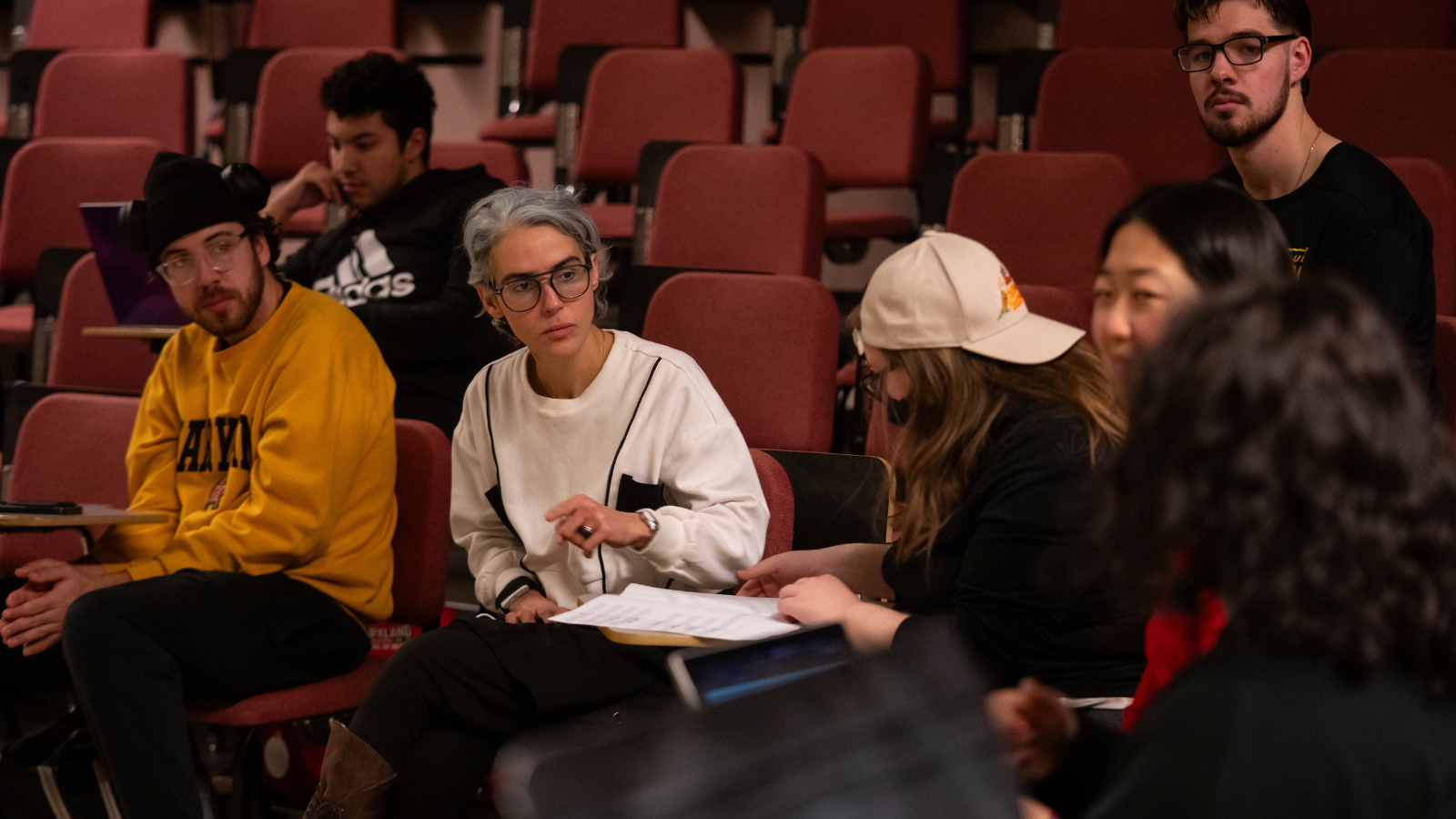
Clarice Assad’s Arts for All residency culminates in a student-created album.
By Jessica Weiss ’05
Flute and piano unfold into a lush, meditative soundscape. Then, as the crackling sounds of a wildfire emerge through the speakers, it fractures into honking horns, rageful screams and other sharp bursts of noise. At the center of the room, Clarice Assad, a Grammy Award-nominated composer, vocalist and educator, leans forward in her chair, eyes closed, then suddenly opens them wide, pumping her fist. “Wow,” she mouths.
The track, titled “Forest Memory,” is one of six student compositions created this semester in Clarice Assad’s course in the UMD School of Music as part of her semester-long Arts for All residency. Together, the works form a collaborative concept album exploring climate change and environmental justice through sound, titled “Voices for Tomorrow.”
For Assad, moments like this are intentional. “If people are connected and really listening to one another, communication opens up,” she said, adding that she views music as a way to create shared spaces that invite people “out of their comfort zones” and into conversations around difficult ideas.
That philosophy sits at the heart of Arts for All’s Artist-in-Residence Program, which brings leading artists and creative scholars to campus to explore how the arts can spark dialogue, innovation and social impact around pressing issues.
“Clarice brought a real burst of energy and a way of thinking that students don’t always encounter in traditional training,” said Craig Kier, professor of conducting & ensembles and voice/opera and the director of Arts for All. “She saw her students as collaborators. They improvised, they took risks, and she helped them connect their artistry to something larger than just their own personal practice.”
In October, Assad presented a workshop at The Clarice with the Office of Sustainability that invited members of the campus community to explore how climate change impacts everyday life. During the session, participants used voice, body percussion and improvisation to build collective sound, discovering how quickly a room of strangers could become a creative ensemble.

“What stood out to me was how she worked with people who weren’t trained musicians,” said John Pablo Rojas, a first-year master’s student in cello performance. “She could get really coherent musical ideas out of anyone really quickly. That was the moment I realized this was someone I could learn a lot from.”
The same approach carried into her course, “Environmental Storytelling Through Music & Technology,” where Assad invited students of varying experience levels to experiment with improvisation, field recording and music technology. On any given day, class began with breath and movement before adding instruments and digital tools.
By the time students gathered for a recent listening session, the room felt like a collaborative studio. The student works varied widely, with sounds ranging from chamber music and Gregorian chant to seal calls and video game effects. Assad listened intently throughout, often leaning forward with her eyes closed, then springing to life as a piece shifted or surprised her, her hands gesturing as the music ebbed and flowed.
After the October workshop, Rojas knew he wanted to join Assad’s course. His contribution to the album is a five-minute piece responding to the melting of glaciers and the cascading effects on communities worldwide. Built from layered cello and violin lines, the track incorporates news clips alongside real audio of glaciers collapsing into the sea.
“Using those voices let me take something I’d been reading and hearing about for years and make it my own,” Rojas said. “The music becomes a way to sit with the scale of the problem, rather than just being told about it.”
Senior Amber Lea Bowen-Longino ’26, a trumpet performance major also pursuing a B.A. in public policy with a sustainability focus, said the course allowed her to connect her two fields of study. Her piece focuses on flooding and builds a soundscape from unconventional sources, including wine glasses tuned with different water levels.
Assad also encouraged Bowen-Longino to move beyond trumpet and use her voice as expressive material, then to manipulate it digitally to convey stress and disorientation.
“She was constantly encouraging us to experiment and take risks,” Bowen-Longino said. “It doesn’t feel like there’s one ‘right’ way to do anything, which makes the creative process really exciting.”
Throughout the course, students worked with traditional and emerging tools, from acoustic instruments and field recordings to digital audio workstations, MIDI controllers and AI-assisted music platforms.
For Assad, the experience was deeply affirming. She called working with the students a “dream” and praised their willingness to take creative risks and support one another throughout the process.
“What this residency shows is how deeply the arts are embedded in our lives, and how they can help students imagine their artistic practice as something that lives beyond the classroom or the concert hall,” Kier said. “Clarice models how you can be both excellent and refined as an artist while also engaging meaningfully with the world around you—and that’s something we need now more than ever.”
Top photo: Clarice Assad sits among students in her course “Environmental Storytelling Through Music & Technology.” Embedded photo: Assad works with John Pablo Rojas during her Voxtopia workshop. Photos by Taneen Momeni.